The Mystery of Satoshi Nakamoto
IDENTITY UNKNOWN
"I've been working on a new electronic cash system that's fully peer-to-peer, with no trusted third party."
— Satoshi Nakamoto, October 31, 2008
Bitcoin's creator remains one of the greatest mysteries in technology history. On October 31, 2008, a person (or group) using the name "Satoshi Nakamoto" published the Bitcoin whitepaper describing a revolutionary digital cash system. By January 2009, the Bitcoin network was live.
Satoshi communicated exclusively through forums and email, never revealing personal details. They collaborated with early developers like Hal Finney and Martti Malmi, fixing bugs and improving the software. Then, in late 2010, Satoshi simply... vanished.
What We Know
- • Wrote in British English (favour, colour)
- • Posted during Eastern/European time zones
- • Deep knowledge of cryptography & economics
- • Mined ~1 million BTC (never moved)
- • Last public message: December 12, 2010
Proposed Candidates
- • Hal Finney (early developer)
- • Nick Szabo (created "bit gold")
- • Adam Back (Hashcash inventor)
- • Craig Wright (claims to be, widely disputed)
- • Group of cypherpunks (theory)
Satoshi's Fortune
Satoshi is estimated to hold approximately 1 million BTC across thousands of wallets—worth over $100 billion at peak prices. None of these coins have ever moved since being mined in 2009-2010. This dormancy is seen as either proof of Satoshi's commitment to decentralisation... or evidence they're no longer able to access them.
Hal Finney - The First Believer
Harold Thomas Finney II
1956 - 2014
Cypherpunk, Cryptographer, Bitcoin Pioneer
Running bitcoin — @halfin, January 10, 2009
This simple tweet would become one of the most famous in cryptocurrency history. Hal Finney was the first person other than Satoshi to run Bitcoin software.
Hal Finney was a legendary figure even before Bitcoin. He worked at PGP Corporation on the first widely-used email encryption, created the first reusable proof-of-work system (a precursor to Bitcoin's mining), and was deeply involved in the cypherpunk movement that dreamed of digital cash.
On January 12, 2009—just nine days after the genesis block—Hal received the first Bitcoin transaction from Satoshi Nakamoto: 10 BTC sent as a test. This transaction (viewable on any block explorer) marked the first peer-to-peer Bitcoin transfer in history.
Key Contributions
- • First person to receive Bitcoin from Satoshi
- • Early bug fixes and testing
- • Helped refine the protocol
- • Created Reusable Proof of Work (RPOW)
- • Worked on PGP encryption
His Final Message
Diagnosed with ALS in 2009, Hal continued contributing to Bitcoin until he physically couldn't. His last Bitcoin Talk post in 2013 is a moving account of his journey. He was cryopreserved after his death in 2014, holding onto hope for the future.
FINNEYPEPE
Counterparty Protocol NFT - Tribute to a Bitcoin Legend
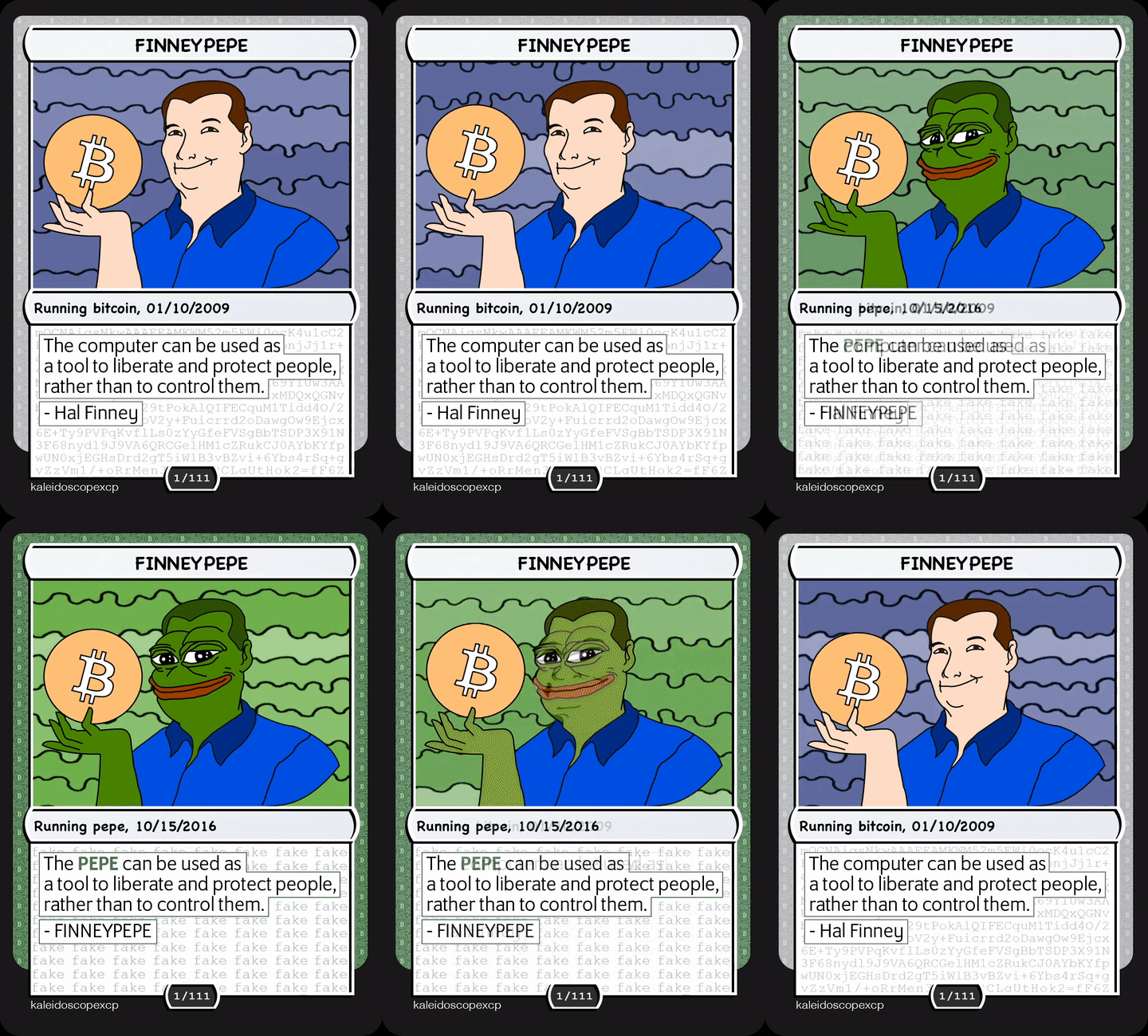
Special Offer: Listed below market rate as a tribute to the Bitcoin community and Hal Finney's legacy.
FINNEYPEPE is a Counterparty protocol NFT—one of the oldest NFT standards, built directly on Bitcoin since 2014. This piece commemorates Hal Finney's pivotal role in Bitcoin's early days.
Enquire About FINNEYPEPE
Interested in acquiring this piece? Fill out the form below and we'll be in touch with transaction details.
Enquiry Submitted!
Check your email for confirmation. We'll be in touch within 24-48 hours.
About Counterparty: Counterparty is one of the oldest NFT protocols, operating on Bitcoin since 2014—years before Ethereum NFTs existed. Rare Pepes and other valuable digital collectibles trade on this protocol.
Bitcoin Pizza Day
10,000 BTC
for two Papa John's pizzas
May 22, 2010
On May 22, 2010, a Florida programmer named Laszlo Hanyecz made history by posting on BitcoinTalk:
"I'll pay 10,000 bitcoins for a couple of pizzas.. like maybe 2 large ones so I have some left over for the next day. I like having left over pizza to nibble on later."
A user in the UK, Jeremy Sturdivant, accepted the offer. He ordered two Papa John's pizzas delivered to Laszlo's home and received 10,000 BTC in return. At the time, those bitcoins were worth about $41.
Today? Those same bitcoins would be worth over $1 billion at Bitcoin's peak prices.
Why This Matters
Laszlo wasn't foolish—he was demonstrating that Bitcoin could work as money. Before this transaction, Bitcoin had no proven use case for real-world purchases. He also invented GPU mining and contributed significantly to Bitcoin's early development. May 22 is now celebrated globally as "Bitcoin Pizza Day."
Fun fact: Laszlo kept buying pizzas with Bitcoin. He estimates he spent about 100,000 BTC on pizza in total. He has no regrets—his goal was to prove Bitcoin worked, and he succeeded.
Lost Fortunes
An estimated 3-4 million Bitcoin (15-20% of total supply) is permanently lost due to forgotten passwords, discarded hard drives, and deceased owners. Here are the most famous cases:
James Howells - The Landfill Bitcoin
8,000 BTC (~$800 million)
In 2013, Welsh IT worker James Howells accidentally threw away a hard drive containing 8,000 BTC he had mined in 2009. The drive ended up in a Newport, Wales landfill where it remains today, buried under 110,000 tonnes of garbage.
Howells has spent over a decade trying to excavate the landfill. He's offered the Newport Council 25% of the proceeds, assembled a team with AI-powered sorting technology, and even sued them—all without success. In 2025, he finally gave up the physical search but launched a cryptocurrency project inspired by the lost coins.
Stefan Thomas - The Forgotten Password
7,002 BTC (~$700 million)
San Francisco programmer Stefan Thomas stored 7,002 BTC on an encrypted IronKey hardware device and lost the password. IronKey allows only 10 attempts before permanently encrypting the contents. As of 2021, he had two attempts remaining. The fortune remains locked away.
Satoshi's Coins
~1,000,000 BTC (~$100 billion)
Satoshi Nakamoto's estimated 1 million BTC have never moved since being mined in 2009-2010. Are they lost forever? Deliberately untouched? We may never know. Many consider these coins effectively "burned," reducing Bitcoin's circulating supply.
The Mt. Gox Saga
850,000 BTC Stolen
~$450 million at the time | ~$85 billion at peak
Mt. Gox (Magic: The Gathering Online Exchange) started as a trading card exchange before pivoting to Bitcoin. By 2013, it handled over 70% of all Bitcoin transactions worldwide. Then it all collapsed.
Timeline of Disaster
- 2011: First hack—80,000 BTC stolen (kept secret)
- 2013: Mt. Gox is world's largest exchange
- Feb 2014: Withdrawals halted; exchange goes offline
- Feb 28, 2014: Bankruptcy filed; 850,000 BTC missing
- 2014-2024: Decade of legal proceedings, creditor claims
- 2024-2025: Creditors finally begin receiving partial repayments
The hack exposed critical lessons about custodial risk. "Not your keys, not your coins" became a rallying cry. Mt. Gox's CEO Mark Karpelès was arrested in Japan but eventually acquitted of embezzlement, though found guilty of data manipulation.
In an ironic twist, creditors who waited 10 years saw their claims skyrocket in value. A claim worth $400 in 2014 became worth tens of thousands by the time repayments began.
Silk Road & Ross Ulbricht
The Silk Road was a dark web marketplace that operated from 2011-2013, using Bitcoin for anonymous transactions. Run by Ross Ulbricht under the pseudonym "Dread Pirate Roberts," it became one of Bitcoin's first major use cases—though not one the community celebrates.
The Numbers
- • ~$1.2 billion in transactions
- • 144,000 BTC seized by FBI
- • Millions of users worldwide
The Outcome
- • Ross Ulbricht: double life sentence
- • Two corrupt federal agents convicted
- • Seized BTC later auctioned (Tim Draper bought)
- • 2025: Ulbricht pardoned by President Trump
The Silk Road proved Bitcoin could facilitate censorship-resistant transactions—for better or worse. It also proved that Bitcoin isn't truly anonymous, as blockchain analysis eventually helped identify participants.
The Genesis Block Message
"The Times 03/Jan/2009 Chancellor on brink of second bailout for banks"
Embedded in Bitcoin's first block - Block 0
Satoshi embedded this headline from The Times newspaper in Bitcoin's genesis block. It serves two purposes:
- Timestamp proof: Proves the block wasn't mined before January 3, 2009
- Political statement: A commentary on the financial system Bitcoin was designed to replace
This message forever links Bitcoin's creation to the 2008 financial crisis and the bailouts that followed. It's a reminder of why Bitcoin was built: to create money that can't be debased by central authorities.
Historic Milestones
First Bitcoin transaction (Satoshi → Hal Finney)
Pizza Day, first exchange (Mt. Gox), $0.01 price
$1 parity, first bubble to $31, WikiLeaks accepts BTC
$1,000 reached, Cyprus crisis, Senate hearings
SegWit activation, Bitcoin Cash fork, $20,000 ATH
MicroStrategy buys BTC, institutional adoption begins
El Salvador adopts BTC, Taproot, $69,000 ATH
US Spot ETFs approved, fourth halving, $100,000+
